A new streetwear founder writes to us almost every week with the same opening line. We are starting our brand, we want to begin with 100 to 200 pieces per colour, can you help us? Most of them have already been told no by three or four factories. The rejection always sounds the same: minimum order quantity is 500 pieces per style, sometimes 1,000.
This is the gap. New brand founders want to start with 100 to 120 pieces per colour because they want to test a product before committing real money to it. Factories quote 500 to 1,000 because below that quantity, the economics get hard. Both sides are being honest about their position. The result is a buyer with a real product idea who cannot find a factory willing to manufacture it.
We built our hoodie manufacturing program around solving this gap. This post is a walk-through of how we do it, what it costs us, and where the limits genuinely sit. Just the actual numbers from our floor in North Karachi.
Why most factories say no to 100 pieces
The factory economics of a 400 GSM hoodie are not complicated, but they are unforgiving.
A 400 GSM fleece hoodie uses approximately one kilogram of fabric per garment. For 100 pieces, that is 100 kg of fleece. The fabric does not come off a shelf. We have to knit it, dye it, finish it, and then cut and stitch it. We always order around 10 to 15 percent extra fabric on top of the actual requirement, because knitting and dyeing have natural waste. On a 100-piece run, that extra is absorbed by the factory. On a 1,000-piece run, the extra is spread across ten times the volume, so it barely shows in the unit cost.
Then there is the machine setup. Setting up the knitting machines for a new fabric specification takes 10 to 12 hours of skilled labour. Calibrating tension, threading, sample-checking, adjusting for the fabric type. That setup time is the same whether the run is 100 pieces or 1,000 pieces afterwards.
The harder constraint is what happens before our machines are even available. Every fabric type requires its own knitting machine adjustment, and the order currently running on a machine has to be fully completed before the next one can start. Factories that have multiple buyers running concurrent orders need to manage the time frame of every order against the machines that are free. From the factory's perspective, a 100-piece slot in the schedule pays the same overhead as a 5,000-piece slot, with much less margin. This is why so many factories simply refuse small orders. The work involved is the same as a larger order, but the return shrinks. Many factories find it easier to say no than to figure out how to slot small runs into a tight production schedule.
How we make 100 pieces work
We approach low-MOQ orders in three honest ways. None of them are secret. They are operational decisions.
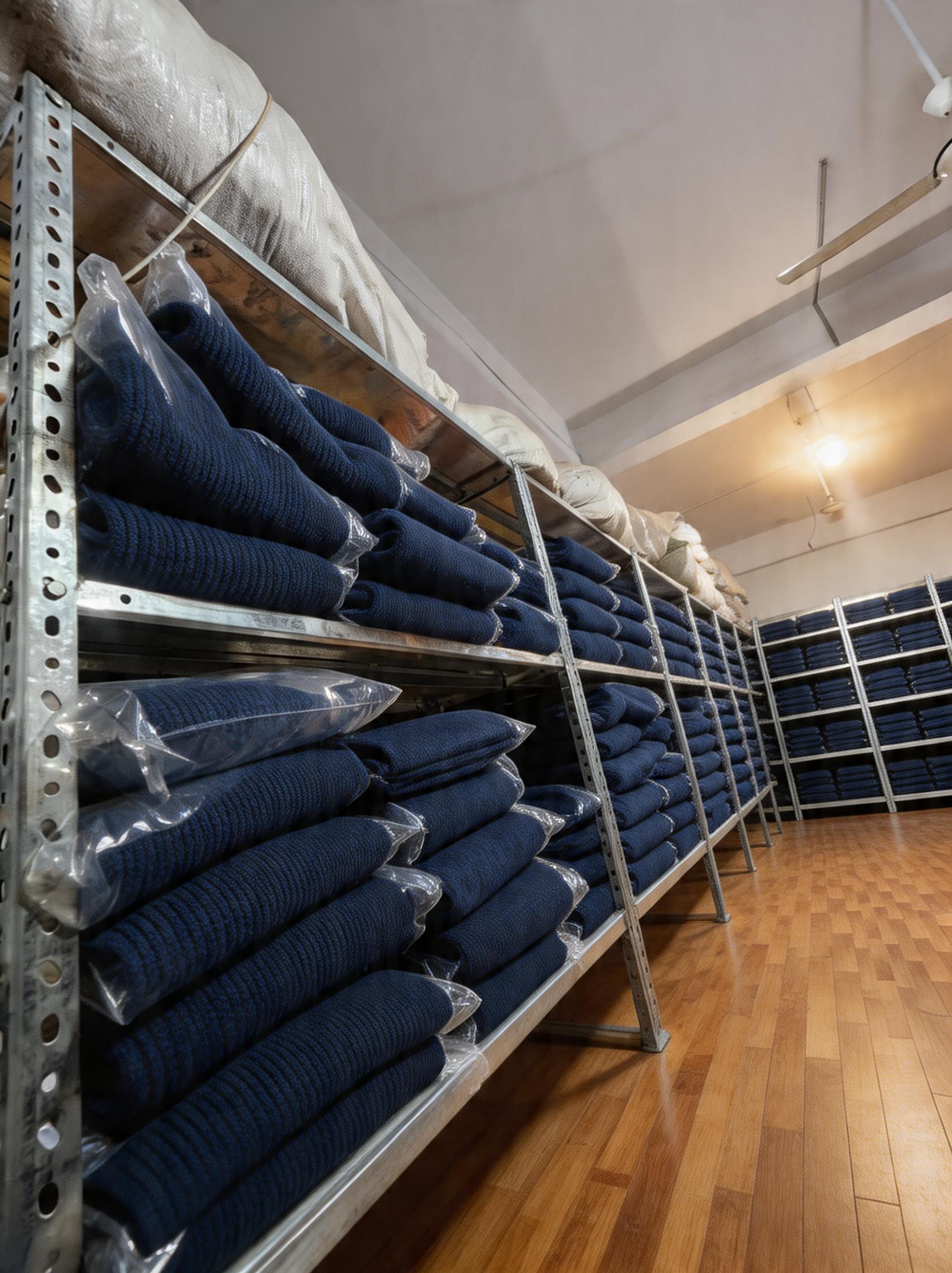
One: we hold stock fabric. At any given time, we keep 260 to 300 GSM fleece on hand in three colours, black, navy blue, and heather grey, in both PC blend and 100% polyester. If a buyer's order falls within these specifications, we do not have to knit and dye fresh fabric. The lead time drops, the cost drops, and we can quote a fair 100-piece price. If the buyer wants a 280 GSM heather grey PC blend hoodie, we have most of what we need ready to go.
Two: we combine dye batches. Our dye-house minimum is 150 to 200 kg per batch, depending on the fabric and product. One fabric roll is around 20 to 25 kg, so a dye batch is roughly seven to ten rolls running together. If two or three buyers come to us in the same week with the same colour requirement, we can combine their orders into one dye lot. The cost of the dye batch is split between them. Everyone gets a cheaper unit price. This does not change the MOQ, each buyer still places a 100-piece order, but the economics work better for everyone.
Three: we accept lower margins on low-MOQ work. This is the honest part. A 100-piece order pays our factory less per piece than a 1,000-piece order. We do not pretend otherwise. We accept this because the buyer is starting a brand, and the brands we work with at 100 pieces today are the brands we work with at 1,000 pieces in two years. If the buyer can sell the product, they will come back. If they cannot, they should not be ordering more anyway. We do not pressure anyone to commit to repeat orders.
When 100-piece MOQ does not work
There are limits, and we say so upfront.
Custom Pantone colours at 100 pieces are not possible for us. Our dye-house minimum is 150 to 200 kg of fabric per batch. For a 400 GSM hoodie, that is 150 to 200 garments worth of fabric being dyed at once. If your colour is custom, you would need at least 200 pieces of that single colour to justify the dye batch on its own. For 100-piece runs, the buyer chooses from our commonly-run colours, which we already keep in stock or run regularly. This is the dye-house reality across most knitwear factories in Pakistan.
BSCI-certified cotton or other certification-heavy materials at low MOQ get complicated. Certifications add documentation, traceability, and minimum-purchase requirements at the cotton source. The real constraint is the yarn supply itself. A 100-piece order of 400 GSM hoodies needs only 3 to 4 bags of yarn, and certified yarn suppliers do not operate at that scale. Certified yarns become feasible only for orders above 5,000 pieces, where the buyer is committing to enough volume to absorb a full certified yarn lot. If your brand requires BSCI cotton, we are usually better off discussing a larger order so the certification chain works cleanly.
Tech packs that are unclear cause us to decline. If we are not confident that we understand what the buyer wants, we say so. A 100-piece run done wrong is a 100-piece run that hurts our reputation and the buyer's launch. We would rather have a longer conversation upfront than ship something that does not match the buyer's vision. This is why the right tech pack matters more for small orders than for large ones. On a 1,000-piece order, a small misunderstanding can be absorbed. On a 100-piece order, a small misunderstanding ruins the whole run.
How long it actually takes
For a 400 GSM hoodie, our production timeline runs 25 to 30 days from approved sample to shipment-ready. This is for any quantity between 100 and 5,000 pieces. The reason the timeline does not scale linearly is that the constraint is not stitching, it is knitting and dyeing. Those processes have minimum batch times regardless of quantity. Stitching scales with quantity, but the upstream processes do not. So a 500-piece order takes the same 25 to 30 days as a 100-piece order. A 5,000-piece order also takes the same time, as long as it is one style and one colour.
Sample lead times are separate. For a standard sample, we deliver in 3 to 5 working days. For a custom sample requiring new fabric or new dye, the timeline is 10 to 14 working days.
The volume question, answered honestly
Buyers often ask how much cheaper their order gets if they commit to 500 or 1,000 pieces instead of 100. We give straight numbers.
Compared to a 100-piece order, a 500-piece order saves 5 to 10 percent per unit. A 1,000-piece order saves 10 to 15 percent per unit.
These numbers are smaller than what some buyers expect. The reason is that fabric cost, dye cost, and stitching labour scale almost linearly with quantity. The fixed costs we absorb on small runs, the machine setup time and the fabric buffer, are real but not enormous. They do not produce a 50 percent price drop at higher volumes. The discount comes from spreading the upstream knitting and dyeing setup across more pieces, not from a different cost structure entirely.
Practical advice for buyers planning a 100-piece run
A few things we tell every founder before they commit to a run.
Use commonly-run fabrics and our PC blend specifications for your first order. It is the fastest path to a fair quote and a clean delivery. Custom GSMs and custom colours are possible at higher quantities, but for a 100-piece test, simpler is smarter.
Sample all your design ideas before deciding which to produce. If you are testing three different hoodie designs and you only have budget for 100 pieces, do not split the order across three styles. The MOQ floor is 100 pieces per style per colour. Take 3 samples of each design, show them to your customers or community, ask which one people actually want to buy. Run the winner at 100 pieces. Splitting your run across designs to test multiple sounds smart, but it is below our floor and it leaves you with 33 pieces of each design, which is not enough inventory to sell into.
Ask any factory to quote multiple compositions and GSMs. A real manufacturer can come back to you within hours with quotes on a 240 GSM cotton hoodie, a 320 GSM PC blend hoodie, and a 400 GSM 100% polyester hoodie. A factory that takes three days to give you any number is either not the actual manufacturer, or they are calculating margins instead of running production. We quote within 48 hours, often within 24, and we will quote across any specification you ask about.
Always insist on a production sample, not just a pre-production sample. A pre-production sample tells you what the design looks like. A production sample, made on the same line that will run your bulk order, tells you what your actual delivery will look like. If a factory will not give you a production sample, that is a red flag.
Visit the factory if you can. Buyers visit us at our facility in North Karachi all the time. We have nothing to hide. A factory that refuses a buyer visit is a clear red flag. If they are unwilling to show you their production floor, you should assume there is something there they do not want you to see.
What we ask from buyers
Two things, no more. First, the tech pack or the design details, even if rough. Second, an honest conversation about what you are trying to build. A tech pack alone never captures the full vision. We listen first, then we quote.
If you are starting a brand and you want to manufacture 100 to 500 pieces of a hoodie, t-shirt, or sweatshirt, we can talk through your options. Send us your tech pack or fill out our enquiry form with as much detail as you have. Our team responds within 48 hours.
There is one piece of advice we leave every new founder with. Do not be afraid to try new things. If you do everything the same as others, what advantage will you have?
Faisal Ali, Apex Corporation