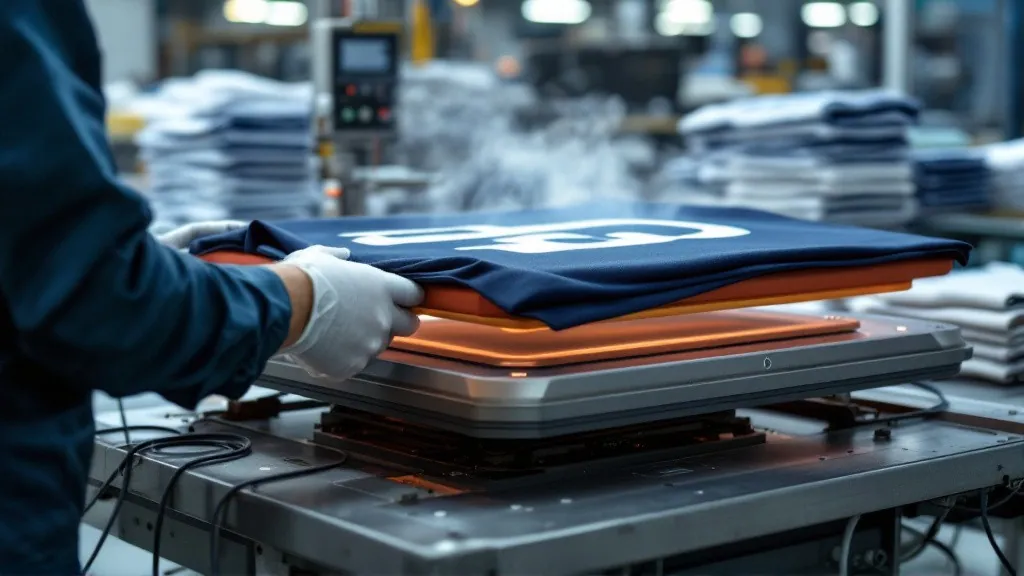
Dye migration is what happens when the dye already inside a polyester fabric bleeds into a print during curing, turning a white print grey or dull. It is a heat-activated chemical reaction, not a defect in the ink or the print itself, and it is entirely preventable with the right process.
Here is what that actually looks like in production.
A buyer ordered 100% polyester activewear trousers in black, with a simple design: white horizontal stripes across the bottom of the right leg. Straightforward artwork, nothing unusual. A few hours after the print was applied, the white had started turning grey.
That is not a design problem. That is a chemistry problem, and it is one most buyers have never heard of because most printing content online is written for print shops, not for the buyers actually sourcing garments.
Why polyester prints differently than cotton
As we covered in our piece on 100% polyester premium, polyester is colored using disperse dye, a process where dye particles get locked inside the fiber itself under heat. That is what gives polyester its excellent wash-fastness. It is also, unfortunately, the exact mechanism that causes the problem.
Disperse dye is heat-activated. So is the curing process used to set most prints. When you cure a print onto a dark, disperse-dyed polyester fabric, the heat that sets your ink can simultaneously reactivate the dye already inside the fabric, and that dye migrates upward into the print itself. A crisp white print sitting on black fabric is the worst-case scenario: any migration is immediately visible, because there is nothing to hide it.
This is exactly what happened with the activewear trousers. We stopped production the moment it appeared and traced the cause. It came down to two variables: the dye's colorfastness under the specific heat and duration of that curing cycle, and the print quality itself. Once we understood the mechanism, the fix was straightforward.
How we prevent it now
Every fabric we print on goes through pre-testing first: rubbing, washing, and perspiration tests that tell us exactly how colorfast the dye is before a single print is applied. On top of that, every print we run now includes an anti-migration agent, a barrier that stops the fabric's dye from bleeding upward into the ink during curing. What used to be a reactive fix is now a standard part of how we approach every order, regardless of fabric color.
If you are working with a manufacturer who has never mentioned migration testing, and you are printing light colors on dark polyester, that is worth asking about before your bulk run, not after.
Choosing the right printing method
We offer six printing methods: screen printing, table printing, sublimation, DTF, rotary, and heat transfer. Which one is right depends on the design and the order, not just the fabric.
For polyester and PC blend orders, DTF and heat transfer are the most common. DTF gives the best result but costs roughly three times what rotary printing does, so it tends to make sense for premium orders or smaller quantities, since rotary printing has its own minimum order requirements that don't work for smaller runs. If a design is all-over rather than a placement print, rotary or digital printing usually makes more sense than DTF. Most buyers hand over artwork and sizing and leave the method choice to us, which is normal since it genuinely depends on technical factors buyers usually can't evaluate as part of our custom knitwear program. But it does create one risk worth knowing about, which we'll get to.
Why PC blends behave differently under print
We wrote in our piece on PC blend ratios that PC blends split their fiber content between cotton and polyester, and that split matters here too. A PC blend, whether 52:48 or 60:40, uses reactive dye for its cotton portion and disperse dye for its polyester portion. Because only part of the fabric carries the heat-reactive disperse dye, PC blends carry meaningfully lower migration risk than 100% polyester does. It's not zero risk, but it's a real difference, and it's part of why the printing method we recommend can change depending on which ratio a buyer is working with.
How long a print actually lasts
Printing method affects durability as much as fabric does. A heat transfer print typically holds up for 10 to 15 washes before it starts to crack. A digital print holds up considerably longer, 30 to 40 washes before fading becomes noticeable. If your product is meant for repeated wear and washing rather than a single season, that difference is worth factoring into which method you choose, not just which one looks best on day one.
The question that prevents a rejected sample
Most buyers never specify which printing method they want. They send artwork and sizing and let the factory decide. That's fine, and often the right call, but it creates one specific risk: if the method we choose doesn't match what you actually wanted in terms of look, feel, or durability, the first sample can get rejected over a mismatch that had nothing to do with the artwork itself.
The fix is simple. Before your first sample, tell your manufacturer which printing method you want, or at minimum, what matters most to you: cost, durability, or premium finish. That one sentence can save an entire sample cycle.
Apex Corporation