A buyer once insisted on 100% cotton single jersey at 240 GSM. We recommended against it and suggested a 60:40 poly-cotton blend in interlock instead. The buyer held firm, wanted the pure cotton look, and placed the order their way.
The result was heavy, dull, and didn't hang the way they expected. Not defective. Just not what they'd pictured when they specified "100% cotton" as shorthand for "premium." A single jersey knit at that weight in pure cotton sits bulky rather than crisp, and the finish reads flat instead of clean.
The buyer reordered, something our 100-piece MOQ makes low-risk to do. Same design, our recommended 60:40 blend, interlock instead of single jersey. The difference was visible the moment the second shipment landed, side by side with the first. Same buyer, same brief, two completely different garments. That is the story we come back to whenever someone tells us cotton content is the only variable worth specifying.
We build every knitted order around getting this ratio right from the first conversation, not after a reorder. As a knitted garment manufacturer in Pakistan, that means the ratio conversation happens before production starts, not after a buyer is unhappy with the result. Here is what actually goes into that number, and the variable most buyers never think to ask about at all.
Our standard ratios, and why they are not arbitrary
Apex works from two standard poly-cotton ratios: 52:48 and 60:40. These are not rounded-off approximations, they are the two blends that consistently give the balance most buyers are actually after, cotton's softness and breathability paired with polyester's strength, shape retention, and shine.
Pure cotton feels natural and breathes well, but on its own it is prone to shrinkage, pilling, and loses shape faster under repeated washing. Pure polyester holds shape and color exceptionally well but can feel synthetic against skin and does not breathe the same way. A poly-cotton blend is a deliberate compromise between those two behaviors, not a downgrade from either one.
Which ratio suits a given order depends on the product. A 60:40 blend, cotton-dominant, tends to suit garments where softness and drape matter most, our T-shirts being the clearest example. A 52:48 blend, closer to even, holds its shape better under stress and repeated wear, which matters for activewear and pieces that get pulled and stretched. We recommend based on the garment's actual use, not just a buyer's instinct about what sounds premium.
The mistake we see most often
Buyers consistently assume more cotton automatically means more premium. It is an understandable assumption, cotton is the fiber people associate with quality and comfort, and it is often true. But it is not a rule.
Sometimes polyester is exactly what a fabric needs to give it strength and shine. A garment that needs to hold a sharp shape, resist stretching out of form, or carry a crisp sheen benefits from polyester content that pure cotton simply cannot provide. Treating cotton percentage as the single measure of quality misses what the fabric is actually being asked to do.
This is the conversation we have with buyers before ratio is finalized, not after. What is the garment for. How will it be worn, washed, and stretched. What does it need to look and feel like a year into ownership, not just on day one. The right ratio answers those questions. A reflexive preference for "more cotton" usually does not.
The one number that does not drift
If you have read about how GSM shifts between sample and bulk, you already know that weight and hand-feel can move slightly between a small sample run and a full production run, for reasons rooted in how knitting and dyeing scale up. Ratio is different. The poly-cotton ratio itself does not drift. What you approve in the sample is what you get in bulk, consistently, because the ratio is set at the yarn and knitting stage and does not shift the way GSM can across dye batches and machine setups.
That makes ratio one of the more stable variables in the entire production process, and one you can specify with real confidence that it will hold. It also means that when a buyer is unhappy with a bulk shipment, ratio is rarely the actual cause. The cause is almost always something else entirely, most often a variable buyers never think to ask about in the first place.
The variable that actually moves the quote: combed vs. carded yarn
Ask most buyers to describe their fabric spec and they will give you a ratio and a GSM. Almost none will mention whether the yarn is combed or carded. That is the gap, because within the exact same ratio, this single choice changes both how the fabric feels and what it costs.
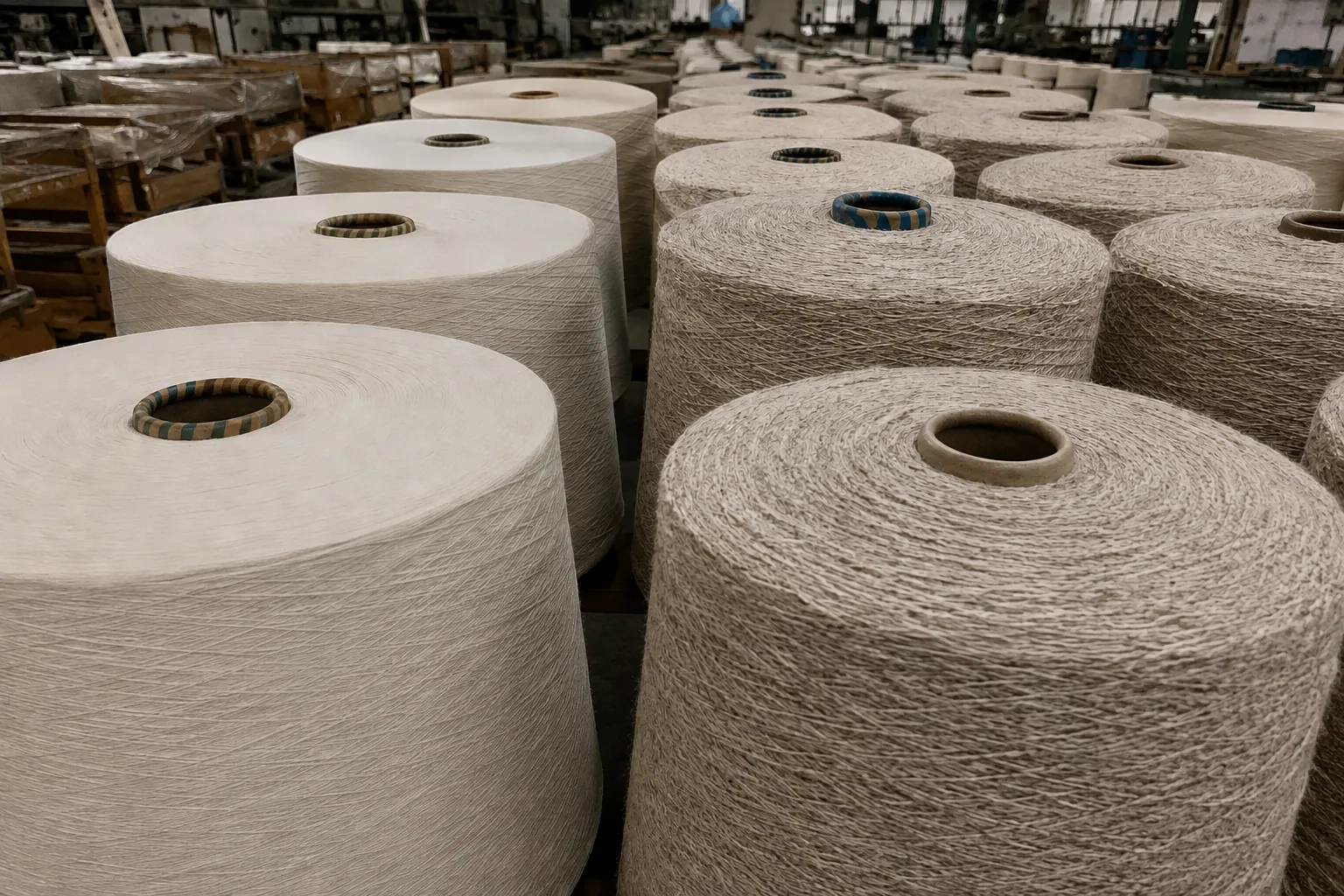
Combed yarn goes through an extra processing step that removes shorter fibers and aligns the remaining ones more precisely before spinning. The result is a smoother feel, less pilling over the garment's life, and cleaner, more even color after dyeing. Carded yarn skips that step. It is a perfectly usable, standard-quality yarn, just rougher and more prone to pilling than combed.
The cost difference is real. Combed yarn can run up to 20% higher than carded, depending on the specific yarn, and that difference shows up directly in the quote whether or not the buyer ever asked the question.
Why two quotes at different prices are not always comparing the same thing
Here is what we have noticed after years of quoting the same specs to different buyers: everyone wants premium quality at a lower price. That is normal. But it creates a specific blind spot. Buyers get used to comparing quoted prices against each other, and in that comparison, they forget to check what is actually inside each number.
Is the yarn combed or carded. How many dyeing processes does the fabric go through. What is the quality of the accessories, zippers, labels, trims, being used. Two quotes can list the identical ratio and identical GSM and still represent genuinely different fabric, because the cheaper number quietly substituted carded for combed, or cut a dyeing step, or sourced lower-grade trims. None of that shows up as a single obvious line item. It shows up in the finished garment.
This is exactly the trap the buyer in our opening story almost fell into from the other direction, assuming a spec change, more cotton, would automatically deliver more quality, when the real quality lever was somewhere else entirely, the right blend and knit for the garment. The lesson runs both ways. Quality is not determined by any single number in isolation, cotton percentage, GSM, or price. It is determined by whether every variable in the spec is actually suited to what the garment needs to do.
What to ask before you approve a ratio
Before locking in a blend ratio, ask your factory two direct questions.
First, for this ratio, are you using combed or carded yarn, and will that affect how the fabric feels after washing? This single question does more work than almost any other, because it surfaces the variable that is invisible on a spec sheet but very visible in the finished garment. A factory with nothing to hide will answer immediately and specifically.
Second, does the ratio you are recommending actually match my GSM target? Ratio and GSM are not independent decisions, what works at one weight does not always work at another, and the right answer depends entirely on what you, the buyer, actually need the garment to do. A factory should be asking you about end use before recommending a ratio, not just filling in a number on a spec sheet.
If a factory can answer both of those clearly and specifically, in writing, that is a factory that understands its own fabric rather than one reciting a price list.
We source yarn for every ratio and every order through a fixed supplier system that prioritizes Apex, which means lead times stay consistent whether an order calls for combed or carded, 52:48 or 60:40. The ratio itself will not move on you between sample and bulk. Make sure the yarn behind it does not quietly move either.
Apex Corporation