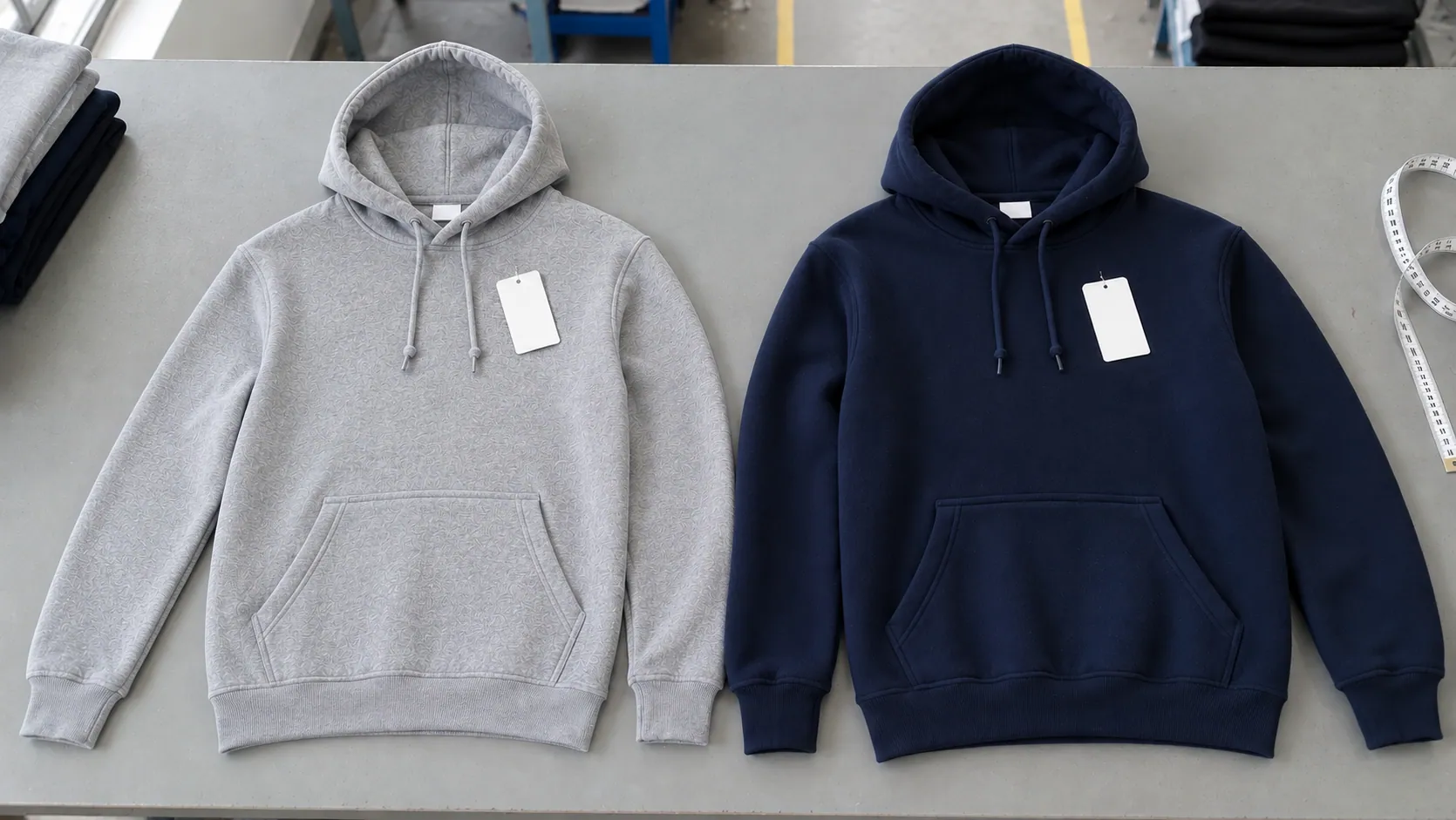
Garment sampling is a two-stage approval. First you approve a fit sample, which confirms the design, size and look. Then you approve a production sample, which confirms the finished garment on the bulk fabric. We start bulk production only after both stages have your written sign-off. Each stage catches a different kind of problem, and skipping either one moves the risk onto your order.
This is how we run it at our factory in North Karachi. If you are ready to start, you can request a sample with the details listed at the end of this post.
What are the steps in the garment sampling process?
1. Inquiry. You send us the garment type, GSM, fabric composition, sizes, color, quantity and print method.
2. Quote. We confirm price, minimum quantity and lead time against your specification.
3. Fit sample. You ask for a sample, we make it and send it by courier.
4. Fit sample approval. You check measurements, fabric feel, color and print, then approve it or send us comments.
5. Order confirmed. We start production to the approved specification.
6. Production sample. When the bulk fabric is in house, we make a sample from it on the line that will run your order.
7. Production sample approval. You approve it in writing before we begin cutting.
8. Cutting, stitching and shipment.
The order matters because of how the fabric reaches us. Dyeing is done by an outside dye-house, so the bulk fabric only arrives in our factory after it has been dyed. That is the earliest point a production sample can be made from the real fabric, and it is why the production sample comes after the order is confirmed and not before.
What is the difference between a fit sample and a production sample?
The fit sample answers one question: is this the garment you want? It checks the pattern, measurements, GSM feel, color direction and print placement. We make it quickly so you can correct things early, when a change costs a few days and not a production run.
The production sample answers a different one: will your delivery look like this? We make it from the actual bulk fabric, after dyeing, on the production line, to your approved specification. Bulk fabric can behave a little differently from the fabric used for the fit sample, and this is the check for that. Many buyers call this stage the PP sample. Whatever name your buyer uses, it should come from bulk fabric, not from sample fabric.
How long does it take to get a garment sample?
A standard sample takes 3 to 5 working days. A sample that needs new fabric or a new dye takes 10 to 14 working days, plus courier time.
What decides which path you are on is whether your request matches what we run every day. For hoodies, that is 260 to 300 GSM fleece in black, navy or heather grey, in poly-cotton or 100% polyester. For T-shirts, it is 160 to 200 GSM in 52:48 or 60:40 poly-cotton. Outside that range we can still make it, but it usually needs a new fabric or a new dye lot. At around 100 pieces, we make your order from stock fabric, which is why the stock colors and GSM range matter so much at that size.
If you need a sample quickly, the fastest thing you can do is choose from the regular range for your first sample. You can still move to a custom specification for the bulk order once you have seen and approved the garment.
Why do garment samples get rejected?
Most rejected samples fail on one of three things, and none of them is the stitching.
Print. This is the most common one. Most buyers do not tell us which print method they want. We then make the sample with the method that suits the fabric, and the buyer was expecting a different look or feel. The sample is rejected, not because anything is wrong with it, but because it was never agreed what it should be. A white print can also turn grey on polyester, and a print can crack or lift after washing. Our posts on printing on polyester and PC blends and on 100% polyester fabric explain which methods hold on which fabrics. Tell us the print method in your inquiry so we make the sample the way we will make the bulk.
Color. On polyester and poly-cotton, color can bleed or shift after washing or heat. Ask us to check the color against your physical reference, not just a screen, because the same color looks different on a monitor than in your hand.
Finishing. Labels, folding, thread trims and measurement tolerance are small things that buyers notice as soon as the parcel opens. Send us your finishing requirements with the inquiry, so the sample is finished the way the bulk will be.
What should I check when a garment sample arrives?
Check the sample against your own specification and not against your memory of it. Measure the key points against your size chart, such as chest, length and sleeve. Feel the fabric and compare the weight and hand with what you asked for. Hold the color next to your reference in daylight. Look at the print placement and the edges of the print, and look at the labels and trims.
Then wash it once the way your customer would. A garment that looks right on the day it arrives can behave differently after one wash, and that is the moment to find out, before the order is cut. Send us your comments in one message, listing every change at once, so we can correct everything in a single round and not several.
Can I get a custom color in a small quantity?
Sometimes, but it depends on the dye-house minimum. A buyer in Canada asked us for a 370 GSM hoodie in royal blue. The color was not one of our stock shades, and the quantity was small. Dyeing a custom color means running a dye lot, and every dye-house has a minimum load that a small order does not reach.
We did not quietly make something close and hope. We told the buyer the options: choose a stock color and keep the quantity, keep royal blue and raise the quantity to justify the dye lot, or keep royal blue and accept the longer custom-dye lead time. The buyer gave us the order.
If your color or GSM is outside the regular range, ask us about the minimum before you commit to a sample. It saves a round of back and forth.
Do I need a fit sample before bulk production?
For a first order, yes. Some buyers go straight to bulk to save time, and a fit sample plus courier adds days. For a repeat order of a garment you already know, skipping it can be reasonable. For a new garment, the risk is simple: if it is wrong, you find out when the full order arrives, not when one piece does.
Buyers who sample first usually finish the order faster overall, because the corrections happen on one garment and not on hundreds.
It also helps to know that every factory has its own sampling policy. Sample charges, who pays the courier, how many rounds are included and how long each round takes all differ from one supplier to the next. Ask each factory you talk to these questions before you compare them, so you are comparing the same thing.
What should I send to get a garment sample?
The more of this you include, the faster we get the first sample right: the garment type with a reference photo or tech pack, the GSM and fabric composition, the size range with a measurement chart, the color with a reference if possible, the quantity, the print or embroidery method with your artwork, and any label and packaging requirements.
We confirm sample charges and terms in your quote, because we quote every order against its own specification.
Apex Corporation